The Basic Habit Loop in Behavioural Science
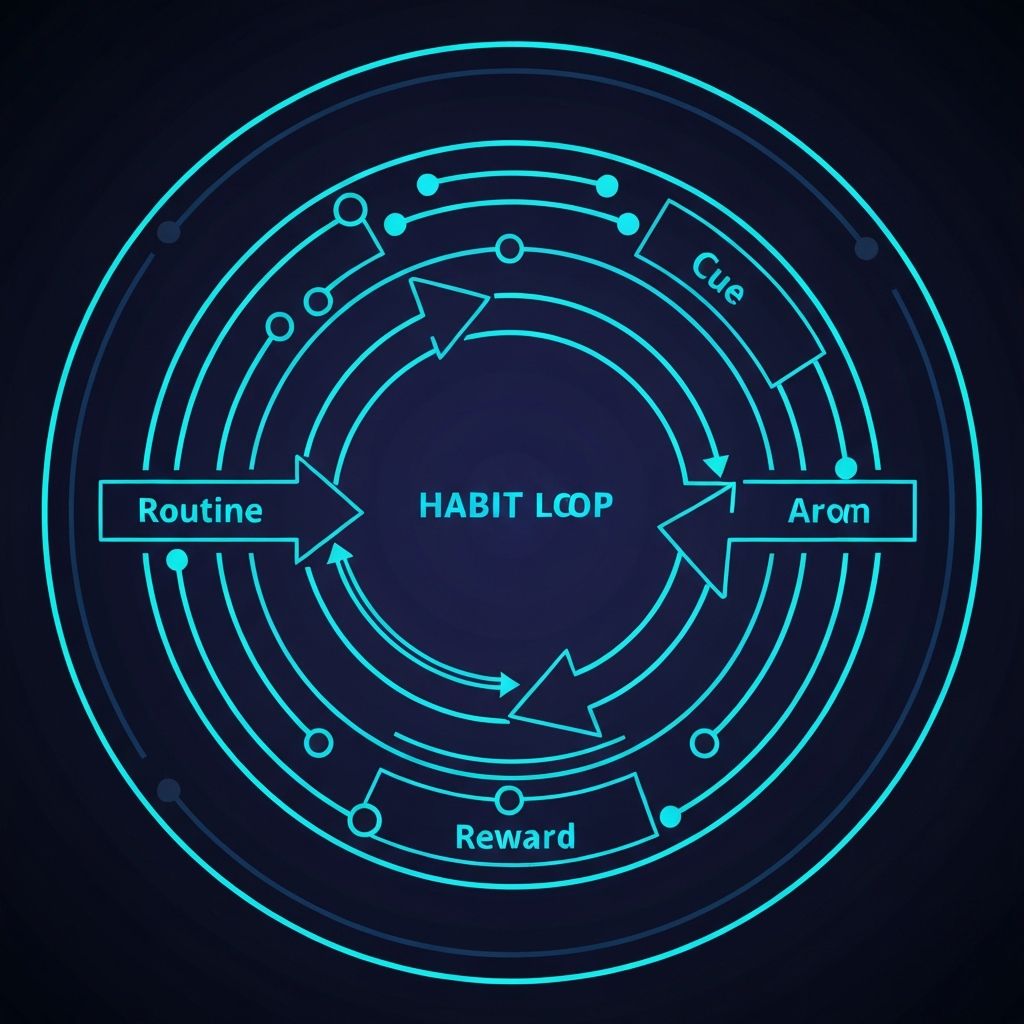
Understanding the foundational mechanism of automatic behaviour development
Core Components
The habit loop model, researched extensively in behavioural neuroscience, describes how automatic patterns develop and persist. The model consists of three essential components that work in sequence:
The Cue
A cue is the environmental trigger or signal that initiates behaviour. Cues can be temporal (time of day), spatial (specific location), emotional (mood state), or sensory (visual, olfactory, or auditory stimulus). The cue activates an existing neural association, prompting the brain to enter "automatic mode."
In the context of daily eating patterns, cues might include: morning alarm (temporal), entering the kitchen (spatial), experiencing stress (emotional), or smelling food (sensory).
The Routine
The routine is the actual behaviour or action performed in response to the cue. Initially, routines require deliberate thought and conscious decision-making. However, through repetition in consistent contexts, routines become increasingly automatic and habitual.
The remarkable aspect of routine automaticity is that it reduces cognitive load—the brain no longer needs to deliberate about the action. This automation occurs through neural pathway strengthening via repeated activation.
The Reward
The reward is the outcome or reinforcement that follows the routine. Rewards drive behaviour persistence by creating positive associations. They need not be objectively beneficial; psychological, emotional, or social rewards are equally powerful in habit formation.
Importantly, the brain learns to anticipate rewards. Once a habit is established, the brain's reward prediction system activates upon cue presentation, even before the reward occurs. This anticipation maintains habit strength.
The Loop Mechanism
The three components function as an integrated cycle. When repeated consistently, the neural circuits supporting the entire sequence become strengthened and interconnected. This neural linking is the foundation of automaticity.
Repetition and Consistency: The loop becomes more automatic with each repetition. Consistent context matters substantially—performing the routine in the same environment, at the same time, creates stronger associations than variable contexts.
Neural Adaptation: Through a process called long-term potentiation, frequently activated neural circuits show increased responsiveness and require less activation energy. This is why established habits feel effortless.
Educational context: This article explains the mechanism of habit formation as observed in behavioural research. It does not prescribe applications or outcomes.
Applied Understanding
Understanding the habit loop provides insight into why certain daily patterns persist despite conscious intention to change them. When environmental cues remain constant, the automatic pattern continues to activate even if the behaviour no longer serves the original purpose.
This explains why environmental context plays such a crucial role in behaviour patterns. Stable environments reinforce consistent habits, while environmental changes can disrupt established patterns.